ServicesGutters
Gutters in Elsmere, Set Up for the Season Ahead
We install and repair one-piece aluminum gutters and downspouts so rain leaves your roof and moves away from your foundation. Each run is sized for the roof above it, pitched to drain and hung on hidden hangers that hold under snow and ice. Every job starts with a free estimate.
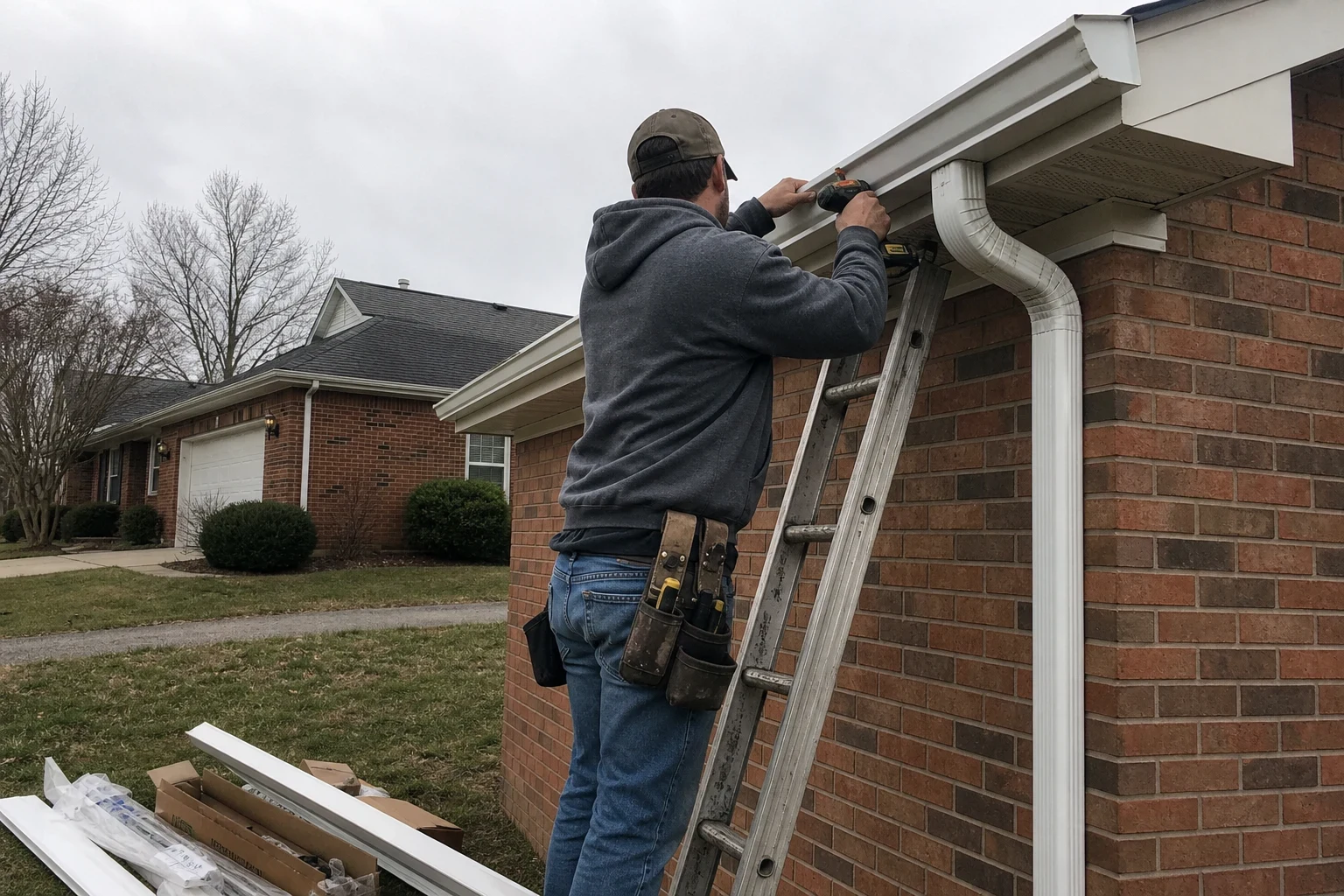
What good gutters do for your home
Gutters are the last step in your roof's water path. When they sag, clog or pull away, water spills behind the fascia, soaks the soil beside the foundation and splashes back onto the siding. Most of the trouble we see starts small: a hanger that let go, a seam that drips, a downspout that empties onto the driveway and refreezes overnight.
We time gutter work to the calendar. Late summer and early fall are the best windows to replace or rehang gutters, before leaves come down and before the first hard freeze in Northern Kentucky. Spring is when we track down the leaks that showed up during snowmelt. Planning a season ahead means the work fits your schedule instead of the weather's.
Because gutters sit on the roof edge, we also look at the drip edge, the bottom row of shingles and the fascia board while we are up there. If something needs attention, we show you a photo and you decide what happens next.
What comes with a new gutter system
Continuous runs, shaped at your home
Our crew brings a coil of aluminum and a gutter machine to your driveway, so each length stretches unbroken from one corner of the house to the next. With no joints along the straight sections, there are far fewer spots that can drip. You pick a color that sits quietly with your trim.
Sizing matched to your roof
A large or steep roof plane can overwhelm a standard 5-inch gutter in a hard storm. We measure the roof area draining into each run and recommend 5-inch or 6-inch K-style gutters with 2x3 or 3x4 downspouts to match.
Hidden hangers and correct pitch
Hangers go in every couple of feet and fasten into solid fascia or rafter tails, not just the trim. Each run slopes gently toward its outlet so water does not sit in the trough and freeze.
Sound wood behind every run
We press and test the fascia boards for rot ahead of installation, and we make sure the drip edge laps into the trough so water cannot slip behind it. Any rotted board is swapped out first, giving the new gutters a solid base to hang from.
Downspouts that carry water away
We place outlets where water can be led well clear of the foundation, adding extensions or splash blocks where the ground slopes back toward the house.
Repairs and gutter guards
Not every system needs replacing. We reseal seams and end caps, rehang sagging sections, clear blocked downspouts and fit guards where heavy tree cover keeps filling the trough.
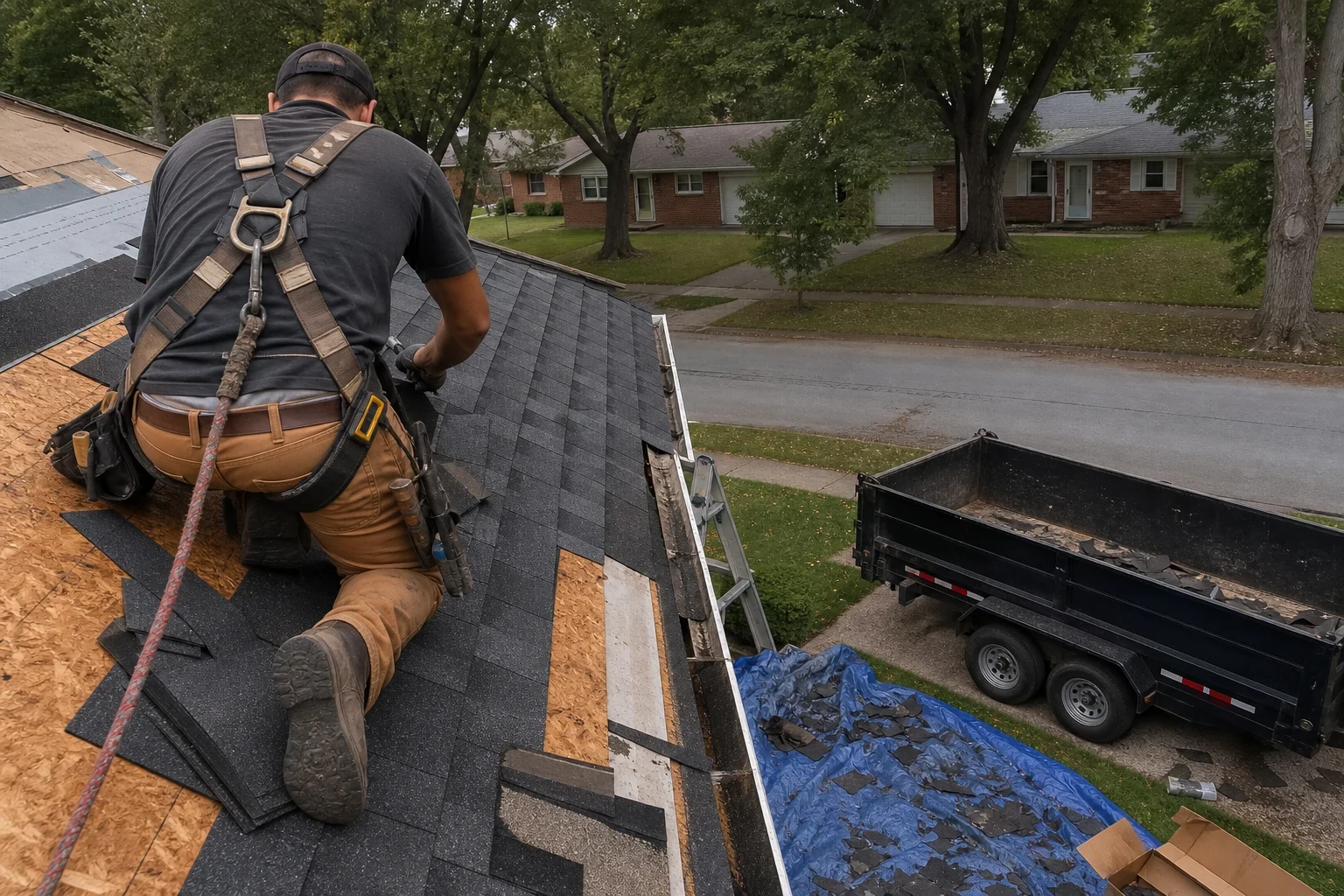
Signs your gutters need attention
- Rain spilling over the lip
- When water sheets over the outer edge during a storm, something is keeping it from the outlet. Usually that is debris packed in the trough, a run too small for the roof above, or a slope that tilts away from the downspout.
- Sagging or gaps at the fascia
- A run that dips in the middle or has pulled away from the house usually means failed hangers or soft wood behind them.
- Stains and peeling paint below
- Streaks on the siding or flaking paint on the fascia show where water is escaping behind or between sections.
- Heavy icicles after a cold snap
- Long icicles and ice packed in the trough point to water that cannot drain. The weight bends hangers, and backed-up ice can push meltwater under the first course of shingles.
- Washed-out beds or a damp basement
- Soil carved away under a corner, or a basement wall that darkens after storms, often traces back to a downspout dumping water in the wrong place.
- Rust and dripping seams
- Older steel or sectional gutters rust at joints and end caps. A few drips can be resealed; widespread rust is usually the point to replace.
How a gutter job runs
- 1
Free estimate at your home
We walk the roofline, measure each run, check the fascia and note where every downspout drains. You get a written, line-item estimate along with photos of anything we found.
- 2
A date chosen around the season
We set a day that suits you and the forecast, ideally ahead of leaf drop or just after the spring thaw. We confirm with you the day before we arrive.
- 3
Careful removal and prep
Old gutters come down in sections, damaged fascia is replaced, and we cover plantings and walkways below the work.
- 4
Install and water test
New runs are shaped, hung and sealed at the corners and outlets. We run a hose through each section to confirm water reaches the downspouts and leaves the house.
- 5
Cleanup and walk-around
We gather old metal, screws and debris, then walk the house with you and show where each downspout now drains.
What moves the price of gutters
Gutter pricing comes down to how much there is, how hard it is to reach and what the wood behind it looks like. Your written estimate lists each item on its own line, so nothing appears later that you did not see first. If we have not worked for you before, mention this when you call: Limited Time — $50 Off Your First Service Call.
- Total length and corners
- The overall footage of gutter is the starting point. Each corner, inside or out, takes extra cutting, mitering and sealing, so a roofline with many turns costs more than a straight one.
- Height and access
- Two-story walls, steep roof pitches and tight landscaping call for more ladder work and setup.
- Fascia condition
- Sound boards need nothing extra. Soft or rotted sections are replaced before hanging, and that wood and labor show up on the estimate.
- Size and add-ons
- Six-inch gutters, larger downspouts, extensions and guards each add material, but they can save a lot of cleanup and repair later.
Gutter questions we hear often
- When is the best time of year to replace gutters?
- Late summer into early fall works best, because the new system is in place before leaves fall and before freezing nights. Spring is also a good window once the thaw is over. We avoid deep winter when we can, since sealants cure slowly in the cold and frozen ground makes ladder footing less steady.
- Do my gutters need replacing, or will a repair do?
- Many times a repair is enough. Hangers that have worked loose, a joint that drips and a downspout packed with leaves can all be fixed without new metal. If rust has eaten through in several spots or the runs are undersized for the roof, we will tell you plainly and show you why new gutters are the better spend.
- Are gutter guards worth adding?
- They earn their keep under heavy tree cover, where troughs fill every fall. With few trees nearby, regular cleaning is usually enough. We will tell you honestly which camp your house falls into after we see it.
- Should I replace gutters before or after a new roof?
- If a roof replacement is likely in the next year or two, it is worth planning both together, because the drip edge and gutters meet at the same edge. We can price them side by side so you can decide on timing. Our Roof Inspections page explains how we judge how much life a roof has left.
- Do you work outside Elsmere?
- Yes. We handle gutter work for homes in Erlanger, Florence, Independence, Fort Mitchell and the surrounding area. The Service Areas page lists the towns we cover.
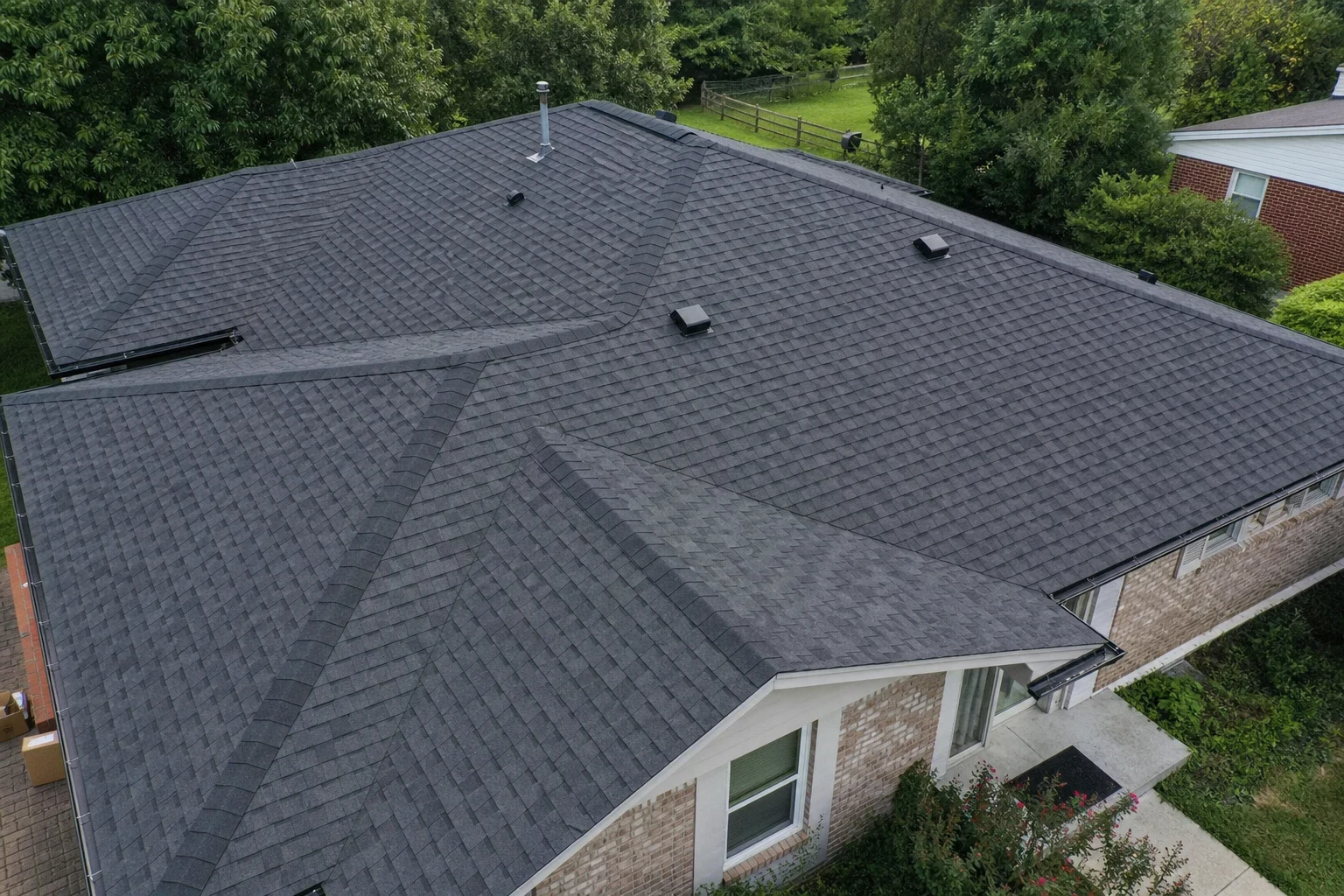
Get your gutters ready before the leaves fall
We will measure your roofline, check the fascia and explain what your gutters need for the months ahead. The estimate is free and comes with photos of what we found.